Courses
11 courses available

This free introductory session lasts up to 25 minutes and is an opportunity for us to get to know each other before starting regular lessons. We'll discuss your learning goals, current level in physics, any topics you find challenging.
This free introductory session lasts up to 25 minutes and is an opportunity for us to get to know each other before starting regular lessons. We'll discuss your learning goals, current level in physics, any topics you find challenging.
- Receive recommendations for the best learning approach.
- Know what to expect from future lessons.
- Decide whether you'd like to continue with regular tutoring.
25 min
1-session program
An introductory course building the skills needed for future physics studies.
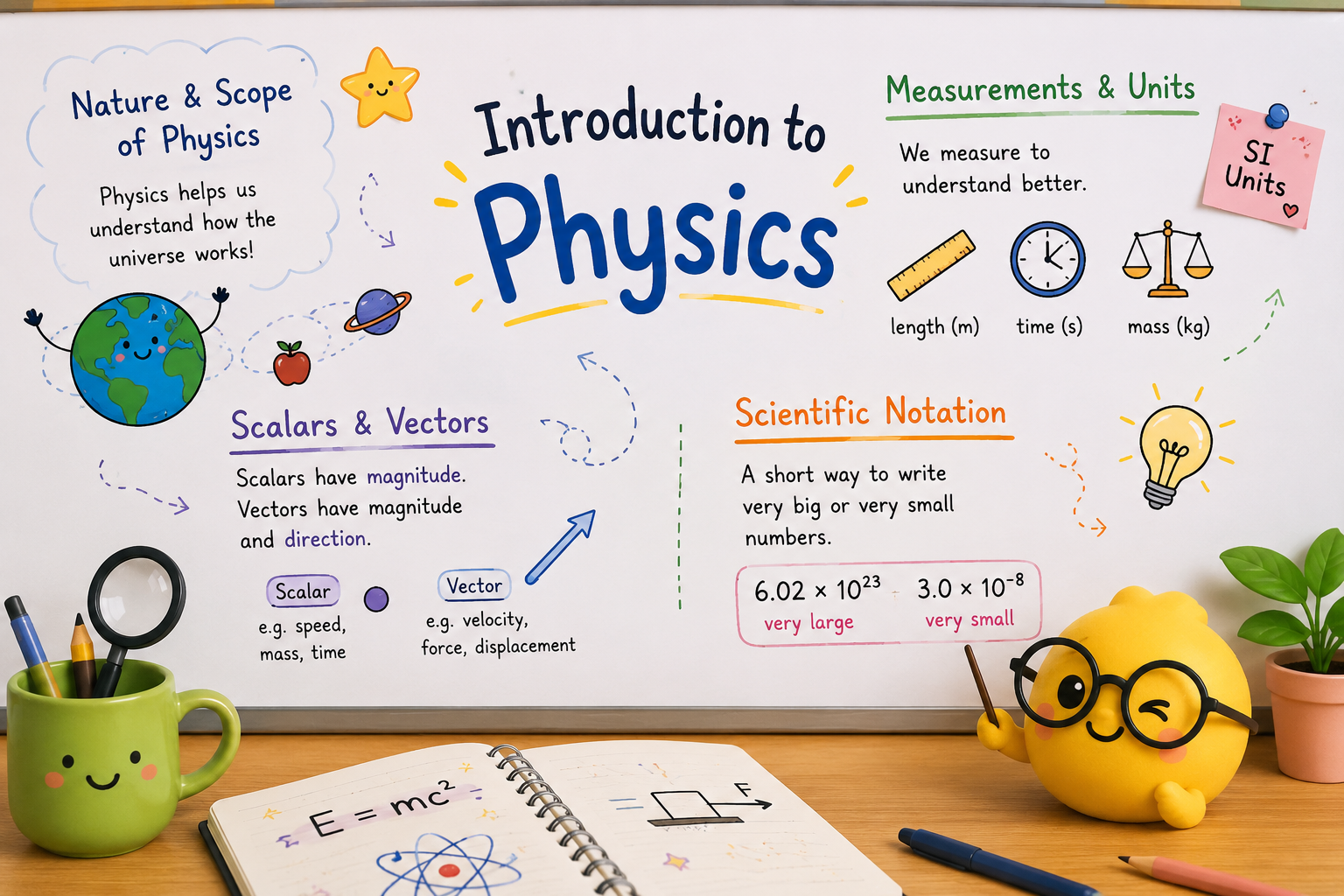
An introductory course building the skills needed for future physics studies.
- Use SI units and measurement techniques accurately.
- Apply scientific notation to represent and calculate large and small quantities.
- Distinguish between scalar and vector quantities.
- Perform basic vector operations and representations.
- Apply foundational physics concepts and mathematical skills to solve simple problems.
- 1 Session 1: Introduction to physics, its scope, applications, and scientific thinking.
- 2 Sessions 2-3: Measurements, physical quantities, SI units, accuracy, and precision.
- 3 Session 4: Scientific notation and powers of ten.
- 4 Sessions 5–6: Scalars and vectors, vector representation, and introductory vector operations.
50 min
6-session program
Discover how objects move, using mathematical models and graphs
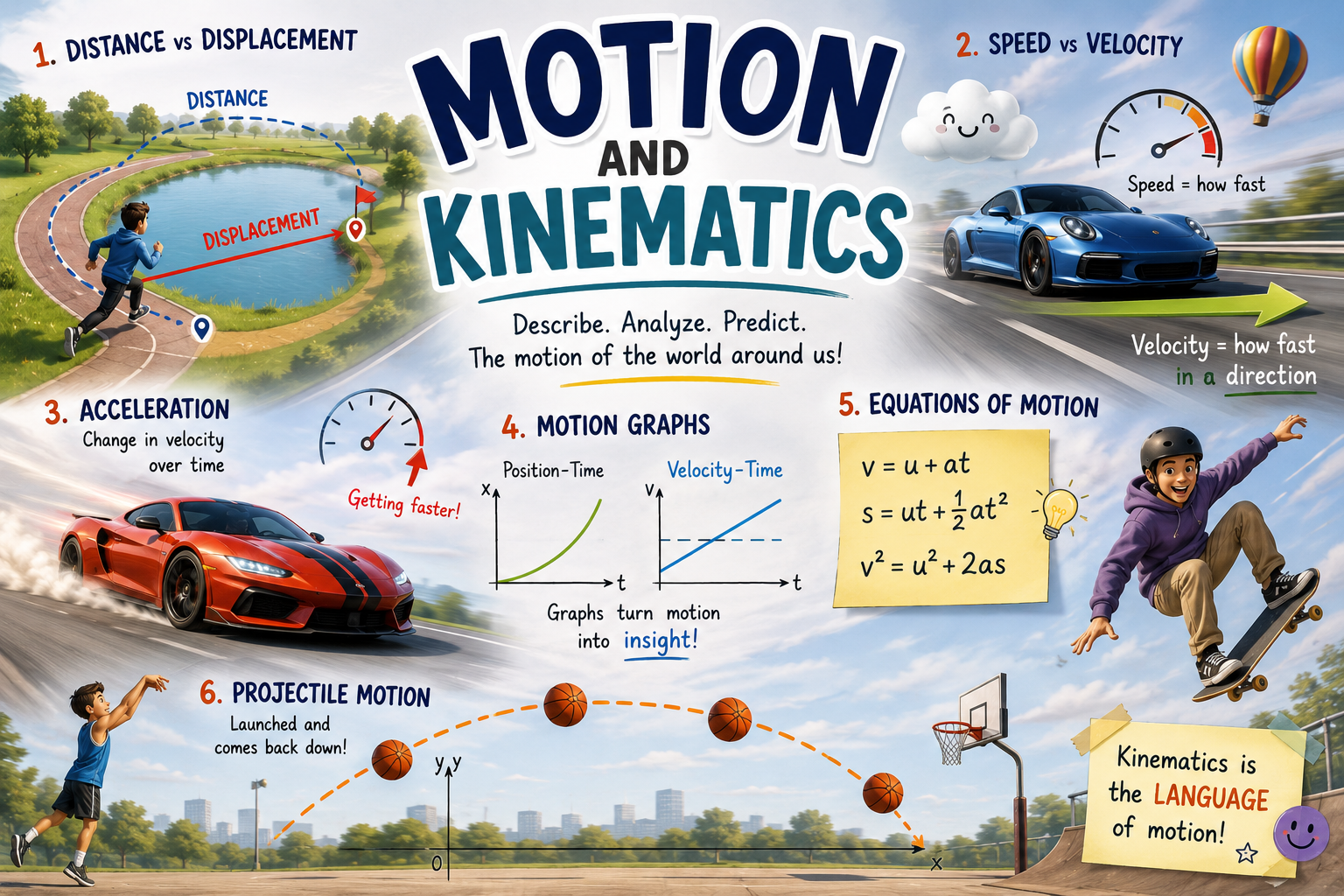
Discover how objects move, using mathematical models and graphs
- Distinguish between distance and displacement, and between speed and velocity.
- Calculate velocity and acceleration in various motion scenarios.
- Interpret and analyze motion graphs.
- Apply equations of motion to solve kinematics problems.
- Analyze projectile motion using horizontal and vertical components.
- Use mathematical reasoning to describe and predict motion.
- 1 Session 1: Introduction to motion; reference frames; distance and displacement.
- 2 Session 2: Speed and velocity; average and instantaneous motion.
- 3 Session 3: Acceleration; uniform and non-uniform motion.
- 4 Session 4: Distance–time and displacement–time graphs; interpreting motion graphs.
- 5 Session 5: Velocity–time graphs; graph analysis and motion relationships.
- 6 Session 6: Equations of motion for uniformly accelerated motion; problem-solving applications.
- 7 Session 7: Projectile motion; horizontal and vertical motion components.
- 8 Session 8: Projectile motion applications; integrated review and kinematics problem-solving.
50 min
8-session program

Learn how forces influence motion and how Newton's Laws explain the movement of objects.
Learn how forces influence motion and how Newton's Laws explain the movement of objects.
- Identify and describe common forces acting on objects.
- Apply Newton's Laws of Motion to explain and predict motion.
- Analyze the effects of balanced and unbalanced forces.
- Evaluate the role of friction in everyday and physical systems.
- Explain circular motion and the concept of centripetal force.
- Solve basic mechanics problems involving forces and motion.
- 1 Session 1: Introduction to forces; contact and non-contact forces; free-body diagrams.
- 2 Session 2: Newton's First Law; inertia; balanced and unbalanced forces.
- 3 Session 3: Newton's Second Law; force, mass, and acceleration; applications of F=ma.
- 4 Session 4: Newton's Third Law; action-reaction force pairs and real-world examples.
- 5 Session 5: Friction; static and kinetic friction; effects and applications of friction.
- 6 Session 6: Circular motion; centripetal force; everyday examples of circular motion.
- 7 Session 7: Applications of Newton's Laws; integrated problem-solving and course review.
50 min
7-session program
Work, Energy and Power introduces learners to the principles of energy transfer and transformation.
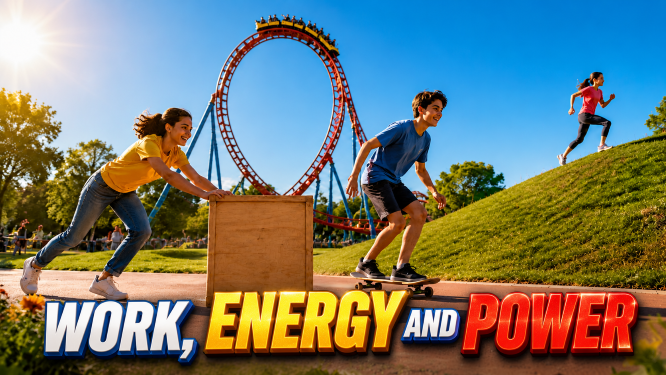
Work, Energy and Power introduces learners to the principles of energy transfer and transformation.
- Explain the concepts of work, energy, and power.
- Calculate work done and energy changes in physical systems.
- Distinguish between kinetic and potential energy.
- Apply the principle of conservation of energy.
- Calculate power and evaluate efficiency in simple systems.
- Solve quantitative problems involving work, energy, and power.
- 1 Session 1: Work; force and displacement; calculating work done.
- 2 Session 2: Kinetic energy; energy of motion and related calculations.
- 3 Session 3: Potential energy; gravitational potential energy and applications.
- 4 Session 4: Conservation of energy; energy transformations and transfers.
- 5 Session 5: Power; rate of doing work; efficiency and real-world applications.
- 6 Session 6: Integrated problem-solving; applications of work, energy, and power; course review.
50 min
6-session program
This course introduces momentum, impulse, and collisions, focusing on how forces over time change motion and how momentum is conserved in interactions and real-world systems.
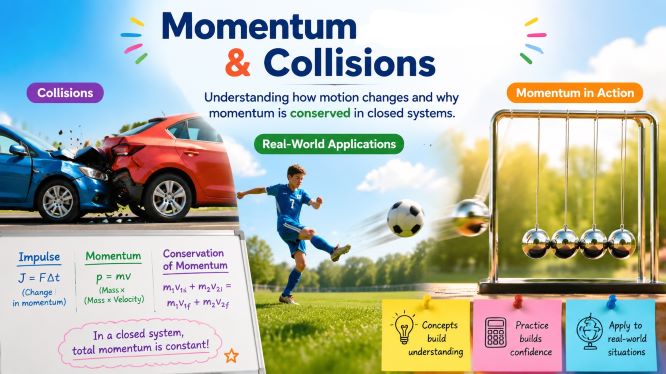
This course introduces momentum, impulse, and collisions, focusing on how forces over time change motion and how momentum is conserved in interactions and real-world systems.
- Define and calculate linear momentum for single and multi-object systems.
- Explain impulse as the product of force and time and relate it to momentum change.
- Apply the law of conservation of momentum to isolated systems.
- Distinguish between elastic and inelastic collisions using energy and momentum principles.
- Solve one-dimensional collision problems using algebraic and vector reasoning.
- Interpret real-world collision scenarios using momentum-time relationships.
- Analyze safety applications such as airbags, seatbelts, and crumple zones using impulse concepts.
- 1 Session 1–2: Momentum basics, including what momentum is, its units, and simple calculations for moving objects.
- 2 Session 3: Impulse and how force and time affect changes in motion.
- 3 Session 4: The link between impulse and momentum change, with basic problem solving.
- 4 Session 5–6: Conservation of momentum in closed systems and solving simple collision problems.
- 5 Session 7: Elastic and inelastic collisions and how energy changes during collisions.
- 6 Session 8: Real-world applications of collisions and a short review of all key ideas.
50 min
8-session program
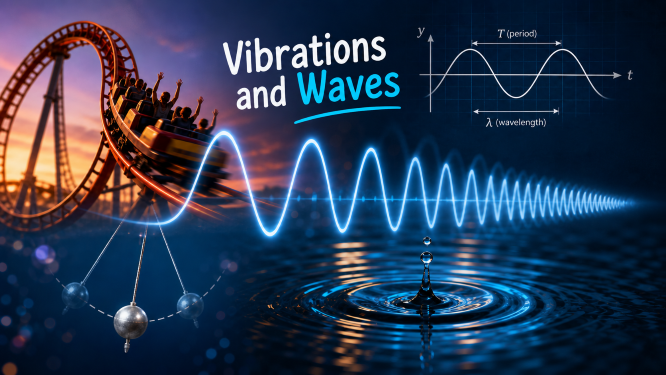
This course introduces periodic motion and the fundamental properties and behavior of mechanical waves, providing the foundation for later studies of sound and light.
This course introduces periodic motion and the fundamental properties and behavior of mechanical waves, providing the foundation for later studies of sound and light.
- Explain periodic motion and simple harmonic motion.
- Apply Hooke's law to simple oscillating systems.
- Distinguish between transverse and longitudinal waves.
- Describe wave properties, including wavelength, frequency, period, amplitude, and wave speed.
- Solve basic problems involving wave speed, wavelength, and frequency.
- Explain wave behavior, including reflection, interference, standing waves, and refraction.
- 1 Session 1–2: Periodic motion, Hooke's law, simple harmonic motion, and pendulums.
- 2 Session 3–5: Wave properties, including wave generation, transverse and longitudinal waves, wavelength, frequency, period, amplitude, wave speed, and related calculations.
- 3 Session 6–8: Wave behavior, including reflection, interference, standing waves, refraction, and two-dimensional waves.
50 min
8-session program
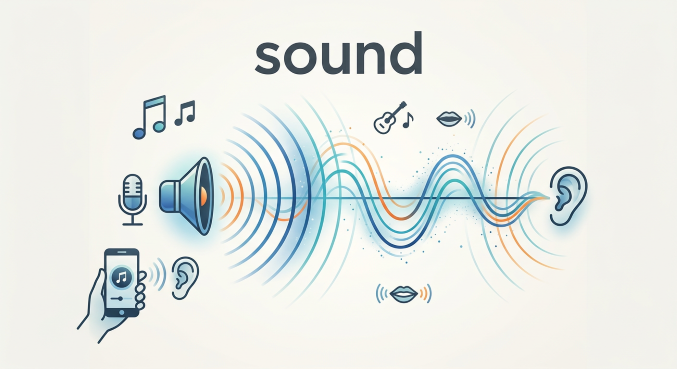
This course introduces the principles of sound, including its production, propagation, properties, applications in music, and the physics of hearing.
This course introduces the principles of sound, including its production, propagation, properties, applications in music, and the physics of hearing.
- Explain how sound is produced and transmitted through different media.
- Describe the properties of sound, including speed, frequency, wavelength, pitch, and loudness.
- Apply the Doppler effect to explain changes in observed frequency.
- Explain the physics of music, including resonance, standing waves, harmonics, and sound quality.
- Describe the structure and function of the human ear.
- Explain applications of sound, including ultrasound and echolocation.
- 1 Session 1–3: Nature of Sound — sound production, propagation through matter, speed of sound, pitch, loudness, intensity, and the Doppler effect.
- 2 Session 4–7: The Physics of Music — resonance, standing waves in strings and air columns, harmonics, sound quality, sound spectra, consonance, dissonance, and musical intervals.
- 3 Session 8–10: Hearing and Sound Technology — the human ear, hearing, ultrasound, echolocation, sonar, and other applications of sound.
50 min
10-session program
This course introduces the sources of light, its wave properties and how light illuminates the universe.
This course introduces the sources of light, its wave properties and how light illuminates the universe.
- Distinguish between luminous and illuminated sources.
- Apply the ray model to describe the propagation of light.
- Explain illuminance and the inverse-square relationship.
- Describe the wave nature of light.
- Explain polarization and the Doppler effect for light.
- Solve basic problems involving the speed, frequency, and wavelength of light.
- 1 Session 1–2: Illumination — ray model of light, luminous and illuminated sources, illuminance, luminous intensity, and the inverse-square law.
- 2 Session 3–5: The Wave Nature of Light — wave model, polarization, speed of light, wavelength and frequency, and the Doppler effect for light.
50 min
5-session program

This course explores the reflection of light and image formation by plane and curved mirrors using ray diagrams and mirror equations.
This course explores the reflection of light and image formation by plane and curved mirrors using ray diagrams and mirror equations.
- Apply the law of reflection.
- Describe image formation by plane mirrors.
- Construct ray diagrams for plane and curved mirrors.
- Distinguish between real and virtual images.
- Use the mirror equation and magnification equation to solve image-formation problems.
- Predict the characteristics of images formed by concave and convex mirrors.
- 1 Session 1–2: Reflection from Plane Mirrors — the law of reflection, plane mirrors, virtual images, and image characteristics.
- 2 Session 3–6: Curved Mirrors — concave and convex mirrors, ray diagrams, real and virtual images, mirror equation, magnification, and image formation.
50 min
6-session program
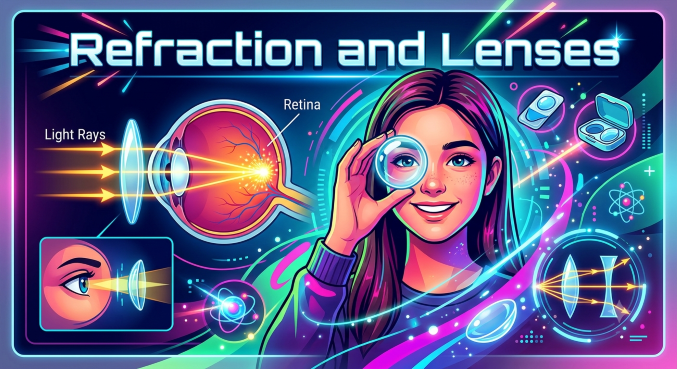
This course introduces the refraction of light, image formation by lenses, and the principles behind common optical instruments and the human eye.
This course introduces the refraction of light, image formation by lenses, and the principles behind common optical instruments and the human eye.
- Apply Snell's law to explain and calculate the refraction of light.
- Explain total internal reflection and dispersion.
- Describe image formation by convex and concave lenses.
- Solve problems using the thin lens and magnification equations.
- Explain how the human eye forms images and how common vision defects are corrected.
- Describe the basic operation of common optical instruments.
- 1 Session 1–3: Refraction of Light — index of refraction, Snell's law, speed of light in materials, total internal reflection, critical angle, dispersion, and optical phenomena such as mirages and rainbows.
- 2 Session 4–7: Convex and Concave Lenses — converging and diverging lenses, principal rays, image formation, ray diagrams, thin lens equation, magnification, image characteristics, and lens aberrations.
- 3 Session 8–10: Applications of Lenses — the human eye, nearsightedness, farsightedness, cameras, microscopes, refracting telescopes, binoculars, and other applications of lenses.
50 min
10-session program